Yaakov Ellis, Boardwalk Talks No. 3
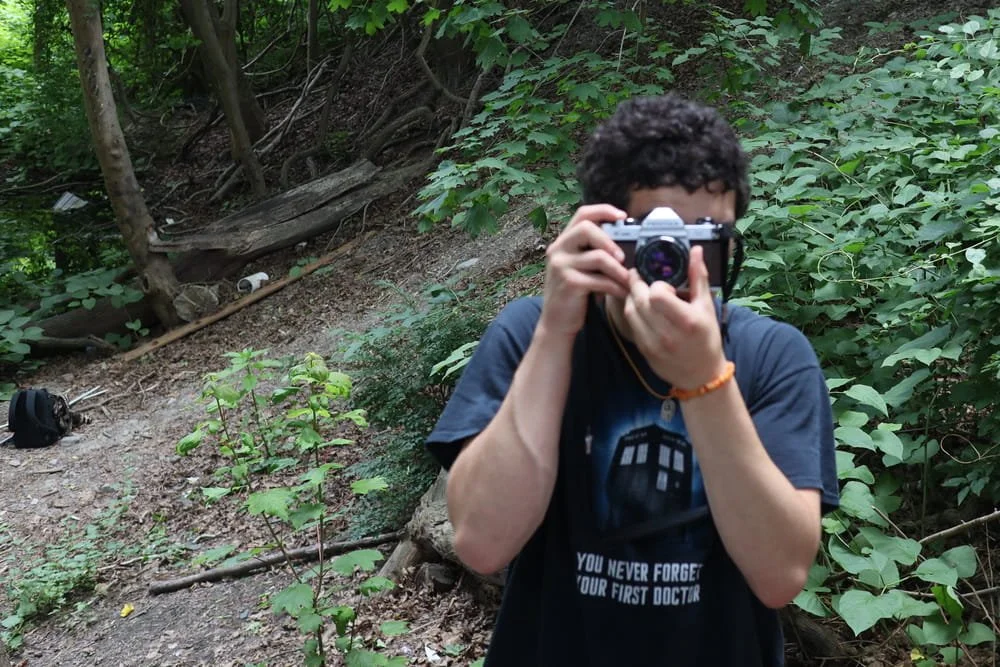
Yaakov Ellis, a photographer and filmmaker.
One Tuesday in the middle of a foggy, sleepy, East Coast suburb, the still-groggy interviewer woke up at 5:30 in the morning—an hour before usual—while outside, all was still. Dawn had yet to break; the temperature hovered somewhere below freezing; the first morning train to the city had not yet roared through the railroad station a few blocks from his home. The interviewer splashed some water onto his face and poured himself a cup of instant coffee. Then, he sighed, before logging onto Zoom to meet with 18-year-old photographer Yaakov Ellis, who was on the campus of the international school he attends in Phuket, Thailand. The time was likewise 5:45 for Ellis, except in the evening—the two were literally on opposite ends of the Earth.
Almost immediately after being admitted, Ellis shouted a loud and enthusiastic greeting. He was seated in a warmly-lit, open area of the building—maybe a lobby or a café—that was decorated with tropical plants. The interviewer could see, through the arched windows in the background, dusky silhouettes of unfamiliar trees. Throughout the entire conversation, Ellis maintained the same convivial demeanor.
There are two themes that are very important to Ellis’ art, and by extension Ellis himself: Human connection and existential angst. The first obsession felt obvious given his gregarious personality; all three of his photographs published in our first issue feature people as the main subjects. The second obsession was evident but hidden in his persona—perhaps unconsciously so—and the interviewer had to look much harder to find it.
Interviewer: Tell me a little bit about your background and where you grew up.
Ellis: I was born in a town called Sharon, in the state of Massachusetts, in the U.S. but I’ve lived in Providence, Rhode Island, pretty much for my entire life. My family's been in the U.S. for about three generations—before that they came from areas like Poland and Russia. And since last year, I've attended an international school in Phuket, Thailand.
Interviewer: Why Thailand?
Ellis: I was really unhappy with the mundanity of my everyday life back home, and I was thinking about dropping out of high school and traveling around the U.S, trying to pursue my passions instead of taking in information that I felt was pointless and didn’t really give me any meaning. Then, I heard about this international school from one of my older brother’s friends, who said he got into this program called United World Colleges that was trying to use education as a force to unite different people and cultures. And I had already wanted to travel, so I signed up and I got accepted. In the program, they have 18 schools all over the world, and based on your application and what they think would be a good fit, they assign you to one of their campuses. I began my first time
Interviewer: How are you liking it so far?
Ellis: It’s definitely nothing like anything I’ve ever experienced. My roommate is from Mongolia. One of my best friends is from Somaliland. I didn't even know Somaliland existed. I’m learning so much firsthand about different people and the places they come from. And then Thailand, being here. Right now, I think it's 6:00 in the morning down on the East Coast, so it’s like 10 degrees, max. Here the climate is tropical year-round, and I find it to be totally different.
Interviewer: When was the first time you tried using a camera?
Ellis: It was about three years ago. My brother was taking me on this camping trip along with his friends. He’s always been kind of a showman. And at one point he’s like, “Hey, you guys, would you like to learn how to shoot?” I don’t know—I had this preconceived notion that I already knew how to shoot, or at least that I had a basic idea of what I was doing. But I quickly realized that I had no idea at all. So he taught me some of the basics of controlling the camera—F-stop, shutter speed, ISO. Later on, I continued trying out his camera whenever I was with him, until he felt comfortable enough to let me borrow it, and I started shooting my friends and making short movies.
Interviewer: What inspired you to take photography more seriously and elevate your art?
Ellis: All my friends are involved in various art forms—they’re singers, or they play guitar or they draw. I wanted to contribute to that overall ambience of creativity. It just felt right. Then, this past summer, I did this Brown pre-college course. Different professors came in and taught us inside of the college setting. I did this course on ecocinema, where I learned how to represent the environment as a character, rather than just a background.
Interviewer: Was there anyone early on who encouraged your creativity?
Ellis: My mom worked in film as a set designer, and she’s been my biggest coach artistically growing up. My father is just a guy that understands humans really well. He’s this crazy, expressive guy, and he taught me how to feel comfortable with expressing myself and be unapologetic about it.
Interviewer: How did the move to Thailand influence your artwork?
Ellis: I’ve always been compelled by street photography. While I lived in a city before, Providence is very different from, for instance, Bangkok or Chiang Mai—those cities are bustling with people and so different from what I’ve always known. So the move has definitely changed how I take pictures. There’s also a different culture surrounding street photography here. It’s more accepted in Providence. Here, I’m more conscious of people’s cultural preference towards modesty and I always make sure that I ask for their consent to be photographed.
Interviewer: Are there any artists that strongly influence your work?
Ellis: When I started watching photography videos, I first watched a lot of Peter McKinnon. I followed a lot of his work. I have some of his presets saved on Lightroom. Beyond that, the director Richard Linklater. A big one is Calvin and Hobbes. I didn’t have a phone or anything growing up. So instead, I read, and I loved being immersed into their world of mischief and imagination and wishful feelings, but also big and scary feelings. I resonated with Calvin, and I try to bring some of his same imagination into my work.
Interviewer: What do you think photography allows you to capture or express that you can’t express as easily in other ways?
Ellis: It’s hard to express in words, because I can only truly express it through my photography. So I’m struggling to describe this quality. There is definitely something. It’s similar to emotions. because it’s something nonverbal. I guess I could say I capture the in-between space that has no name. Like, you can describe somebody blowing out the birthday candles with words, but there’s a weird moment, right before they go to make a wish, that words fail to truly capture. Maybe their face is vaguely sad. But I can capture that with my camera.
Interviewer: Do you ever find that you're returning to certain ideas or feelings in your work again and again?
Ellis: I feel an existential angst, and as corny as it sounds, this angstiness is something I’m really drawn to. Like asking yourself, ‘Is this it?’ I don’t know. I think one of the weaknesses of photos is that sometimes, they can create perceptions of things that didn’t really happen. If all you capture is a smile, then there’s this perception that everything was happy, which may not have been true. This easy distortion of reality often worsens my angst. What is real?
Interviewer: When did those feelings first emerge?
Ellis: Probably as long as I can really remember. Maybe starting around age eight. But I feel like I've always had this awareness of my surroundings and a longing for more. I'm definitely not like a nihilist, but I believe if life is purposeless, that gives us the power to assign our own purpose to things. And in that same vein, it allows us to live to what I believe is our fullest extent.
Interviewer: In the artist statement of “The Major Lift” you described the two fighters being completely absorbed in their own worlds while the chaos erupts around them. Why did that moment draw you in?
Ellis: I’m a wrestler. I've been wrestling since about the age of 12, and it’s been a way to deal with negative thoughts and lack of confidence and self-doubt. And particularly, I enjoy the experience of being in an almost meditative state which you enter when you step into the ring with someone. Especially nowadays, with social media, there’s so much going on around us that those moments of true connection have become really rare. Fighting is one of the few times that we get to experience that. Even just experiencing it from afar, spectating the match, transports you into that little world of complete connection.
There’s been a few times when I’ll be in conversation with somebody, and at some point it slides into the unknown, something almost spiritual. I experienced these moments of pure connection, where I feel like I’m talking to this other person's soul, and it’s quite indescribable. I'd say I live for moments like that.
Interviewer: In the artist statement of “Messy Room, Memories on the Ground” you write that the photograph explores incompleteness as a natural state of life. What draws you so much to these unpolished, candid scenes, more than more so than perfect ones?
Ellis: I get the feeling that what’s perfect is fake. Nothing is really perfect. Perfect narratives are usually false. Instead of striving for perfection, I think we should more often appreciate the beauty in the struggle, where there’s more connection to be found.
Interviewer: In the artist statement of “Is This It,” you said you saw disassociation on the central figure’s face. Do you often project personal emotion into the strangers you photograph?
Ellis: All the time. It’s probably to an unhealthy extent. I portray what I'm feeling onto them. I don't know if what I feel and interpret is true in any way, but it’s my photograph, my narrative.
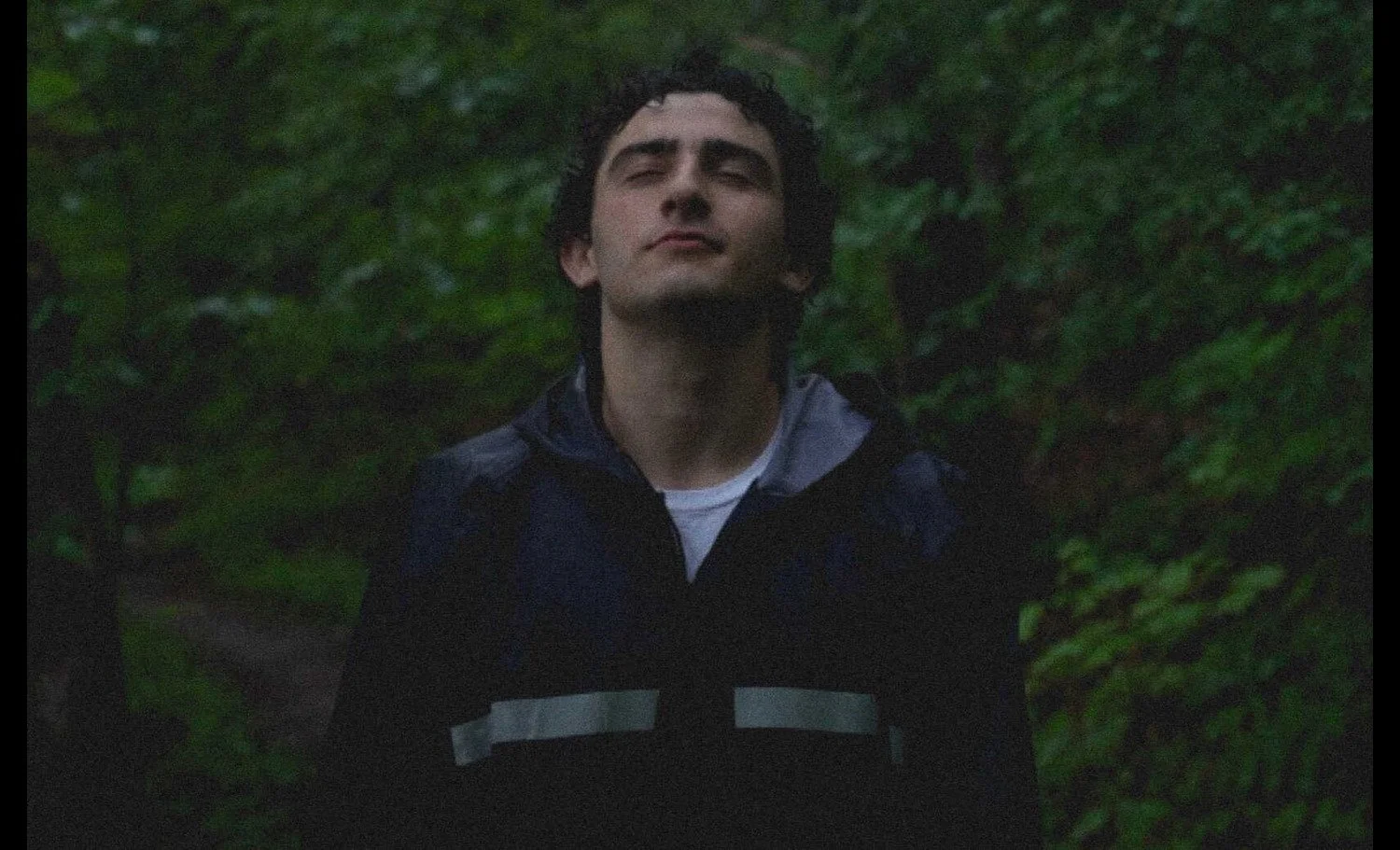
Yaakov Ellis looks toward the camera with his eyes closed.
Interviewer: What are you excited to experiment with next?
Ellis: Instead of telling just still narratives, I want to make more movies. Recently, I made my first short films, which I put on Instagram, which I’m very excited about. Photography might not be my ultimate medium. Maybe film isn’t either. Maybe I’ll go back to pottery or dancing or something else. But I’ll keep making art for the rest of my life.
