Rachel Chitofu, Boardwalk Talks No. 1
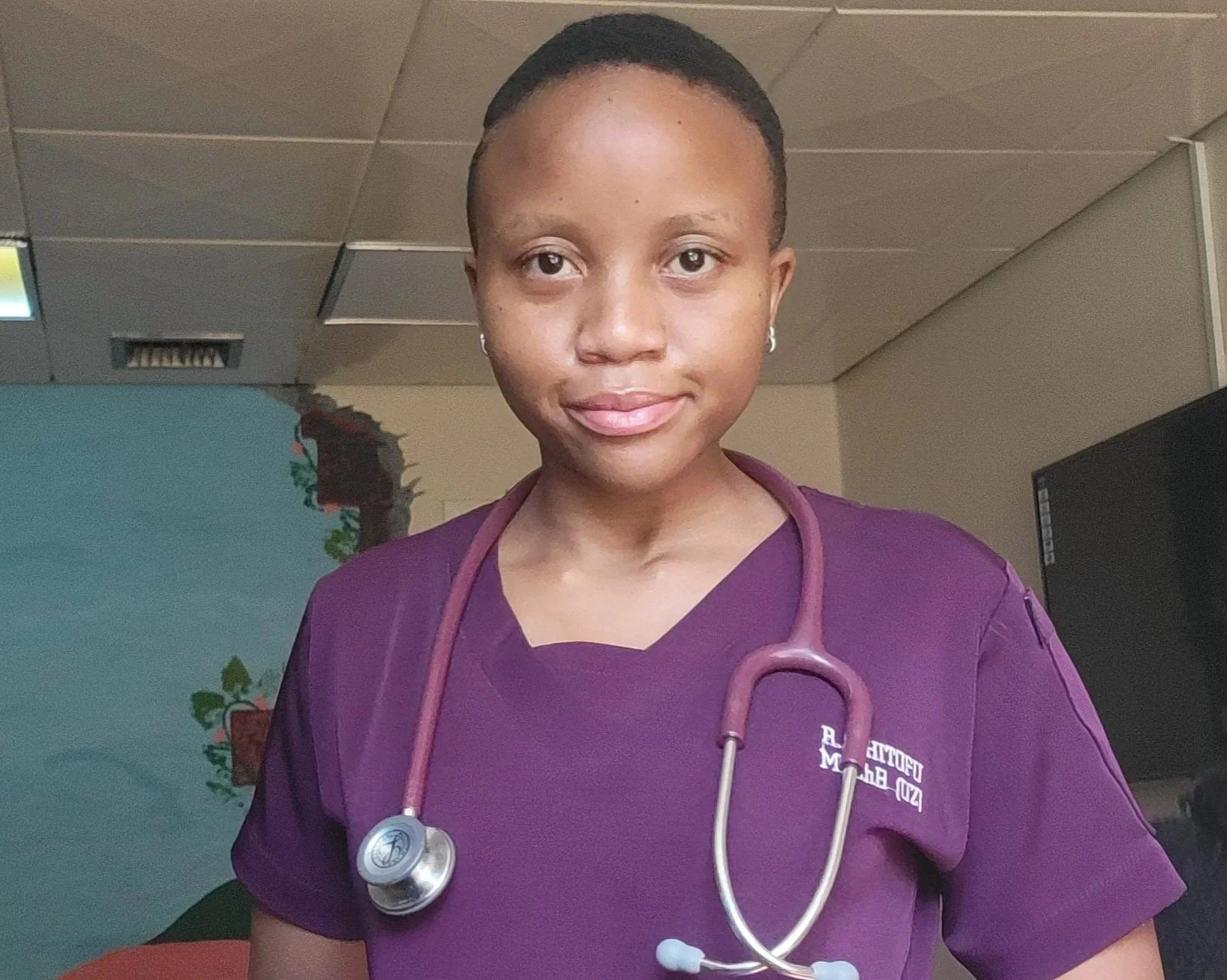
Rachel Chitofu, a poet and medical student, wears a stethoscope.
The interviewer spoke with Rachel Chitofu over Zoom while she was seven time zones away and on the campus of the University of Zimbabwe, where she’s currently in her fifth year of studying medicine. Due to the poor internet connection, her voice sporadically cut to static. She speaks slowly, with a Zimbabwean accent—her native language is Shona—but her words are sharp and dramatic.
A recurring theme in her work is human anatomy. Sometimes, she says, she scribbles small line fragments in the margins of her anatomy textbooks—a poet’s version of procrastinating homework. In the 22 lines of “Stillborn,” she invokes the inner thigh, throat, hand, teeth, mouth, and ribcage. Aside from just imagery, many other characteristics of her poetry are likewise visceral. This may be because much of her inspiration is sourced from grief, which is felt deep inside the unknowable recesses of the body.
Interviewer: Where do you live?
Chitofu: I’m from Zimbabwe. I grew up in Harare, but then later on, I moved to Domboshava, which is mainly a communal area. That shift from the capital city was difficult, but it's something that I'm getting used to. It's also shaped my poetry—a lot of it has been about that shift and grieving for my old home. I am in medical school right now. Fifth year now. I am both a writer and a medical student.
Interviewer: How do you reconcile two interests that are so different from each other?
Chitofu: Most of the time in medical school, I find myself drowning in deadlines and exams. But for me, poetry is the escape. I'm scared, I'm overwhelmed, but I’m still here, I study anatomy all day, which, perhaps surprisingly, meshes well with creating metaphors. I actually think there's a link between poetry, and the body—ribs, breath, wounds, organs, which I study from day to night.
It was, however, always poetry, way before medical school, way before I even thought I wanted to study medicine. When I started studying medicine, I couldn't just discard poetry. It was a place of solace. When I’m having a hard time with school, I can’t always constantly be reading textbooks. So in between the pages, I'll find some space to write some lines, perhaps remix some of the things I have read in anatomy, or my biochemistry lectures. In some of my poems—though not Stillborn—you find that there's a lot of medical jargon. I’m basically studying the body all the time, and the body is one of the greatest themes we can use in poetry—it's a fascinating object that we dissect. Sometimes, it feels like I'm translating things from one language to the other.
Interviewer: What is your earliest memory of poetry?
Chitofu: My earliest memory of poetry dates back to first grade. I remember I used to be in a group of friends where I was the quiet one. Not passive, but the girl that's always following behind everyone else. It was hard for me to communicate. Others could always feel that I was different from all the other children, and not in a good way. I felt different, as in actually behind. But during this time, I found I liked writing words. In first grade, I was one of the worst students in my class. I sucked at English, and I think this actually pushed me to actually want to experiment more with the English language, because the thought that I was having was, ‘Why am I so bad at this? And is there anything I can do about it?’ So I was always trying to make sense of these words that my teacher claimed I could not read nor pronounce. I was always trying to put things together. Eventually, I got pretty good at it. By the time I reached third grade, I was an excellent writer.
Interviewer: When you were starting out as an artist, who encouraged your creativity?
Chitofu: My mother did, but everyone else thought it was a waste of time. I used to do it behind closed doors. I would do it when nobody was watching, because they wanted me to be working out mathematics, solving problems. But all my concentration was on language. English, Shona, my native language. Only my mother would support my writing, and she's passed now. I’m grateful—during the time that she was around, she gave me a platform to be able to express myself without judgment.
Interviewer: Do you study poetry right now in school?
Chitofu: I don't have a class that's actually dedicated to that. But I study alone, which is very difficult, because I also don't really have many poets around me. So I read. I read books. That's the only studying that I ever get to do, reading other people's poems.
Interviewer: In what other ways do you explore poetry?
Chitofu: It's always been reading books, to be honest. But as of late, I've started attending spoken word poetry. I used to have a misconception that poetry in my country is underdeveloped and not respected. It turns out, poetry in my country is great. Zimbabwe has a thriving poetry scene. I've only attended around five open mic events, but they were all amazing.
Interviewer: What does poetry allow you to express that you feel you can’t express in any other way?
Chitofu: I often find myself emotionally exhausted. My brain is very dramatic. Recently, I was diagnosed with ADHD. I’ve always just had so many thoughts coming in at once. And of course, my friends didn't understand this. I've been called all kinds of things, childish, attention seeking, to the point where I'm now afraid to even open up about my emotions to other people. So what poetry is to me is a platform. It's where I go and say, ‘Here I am. I’m a spicy girl. Take it or leave it, but it's here.’ It's an offering and also, a way of honoring my brain, because the rest of the world can't understand it.
In my poetry, there's always emotional conflict and distress. When I’m with other people, I have to pretend that I have things together. I have to pretend that I'm happy, that I'm functional, so that I don't get called the names that I mentioned to you earlier. But with poetry, there's no need to put up that kind of facade.
Interviewer: How do you find the inspiration to begin a piece?
Chitofu: Usually I work without really having any inspiration, because inspiration comes only once in a while. If I wait for inspiration, I'm likely to write three or four lines; it never really gets anywhere. So what I do is I just pick one object or pick a phrase. It could be something that somebody said that's been playing on and on with my head. I take that and I make it my theme, and everything else follows. I can't really call that inspiration. I feel like inspiration is more whimsical and it's a special power that appears to other people, but not me. I just draw my material from what I've witnessed and what's going on around me. I take scenes, various scenes, I take phrases, I put them together.
Interviewer: What ideas and feelings do you find yourself returning to again and again?
Chitofu: I hate having to say this, but since my mom passed away four years ago, even if I'm trying to write a love poem, there's going to be a line about death. It just happens. It's not like I'm actively trying to write about death, but it just naturally happens, because obviously, I haven't gotten over her passing away. The other thing is—I don't know how to phrase this well, but my work is often about conflict, a conflicted soul, conflict that stems from within.
Then there’s also a bit of love. But, with love, it goes both ways. Sometimes it’s platonic love, and then romantic love, and then there's desire too. I won't write a full blown love poem because I'm not quite there yet, so I usually incorporate it through a lot of tiny details, maybe things that I've been experiencing as a young adult—it's like what most people my age speak about all the time!
Interviewer: What poets influence your work?
Chitofu: I would say Sharon Olds and then some of the more bizarre ones. I also like Gabrielle Bates. But, I can't really tell which voices directly influence me, because I read a lot of poets. But, I guess the ones that I mentioned. I also like Frank O'Hara. I read him a lot. Charles Bukowski. I've always wanted to imitate the sarcasm, but I really am bad at that right now.
Interviewer: Can you elaborate on why these poets draw you in?
Chitofu: Well, with Charles Bukowski, I feel like he was a very conflicted person, but I also suspect him to have been mentally ill. I never really found out what kind of mental illness he had, but obviously there was something. He was somebody that didn't live stuck in his mental illness. He found a way to resist everything, and he was quite open about his feelings, even when some of them were very terrible to share. That strikes me as incredibly confident because that's not really something that I possess quite yet—I don't always say what I actually want to say in my poems. If I really had the ability to, I doubt that anyone would read them. At the moment, my poems are very polished, but that's okay. I'll get there. With Sharon Olds, it’s the exact same thing. The way she depicts her childhood, it's brutal. Everything is; the way she talks about war, births, how she paints the body and trauma. It actually feels alluring more than frightening. And then Gabrielle Bates. She’s musical. I find her soothing. I've never really found her as jarring as the aforementioned two. I also have some African poets I like. There's Wole Soyinka from Nigeria. He is amazing. He talks about Africanism in a way that's proud, a way that's very showy, that makes me embrace my culture more.
Interviewer: Are there any contemporary Zimbabwe poets you like?
Chitofu: These are people that are just starting out, but I still have great respect for them. I don't really know their real names, because I only know their stage names. There's one that's called Mazweli. Oh, this one is amazing. She speaks a different language from the one that I speak, because she's from a different province, so she mixes it with English. But it's actually the language that she speaks, her native language, her dialect, that draws me to her work. It's the passion, the fierceness, and it’s driven me to want to learn her language, and I'm currently learning it—it's called Ndebele. She is amazing. She's a very passionate, very fierce young woman. She does both spoken word and written poetry. She's definitely somebody that I look up to, that I wish the rest of the world knew. Maybe one day.
Interviewer: You mentioned in your submission that you want to “Keep your ghosts alive just a little longer.” What does this mean and how do you achieve this through your work?
Chitofu: The ghosts are the parts of me that are tired, fed up, and parts of me that refuse to be polite. I can also say they're the very vengeful parts of me, the ones that any normal person would think I should dispose of. Even though it feels like it's natural to want to get rid of grief, exhaustion, and memories from the past, they allow for a second birthday, a resurrection. That's what keeping ghosts alive is to me. It's refusing to discard what many people think I should be discarding.
Interviewer: What type of emotions do you want the reader to leave with?
Chitofu: There’s a goal that I want to achieve, and that I'm not sure I've achieved yet, but I know I will: I want neurodivergent people to read my poems, especially Black neurodivergent people, because they especially are not allowed to express themselves freely. This is very true in the province that I come from, where it's very restrictive. If you're openly neurodivergent, people might actually call you slow. That's harsh. And this mainly happens in my province, because I think people still haven't been educated enough about the differences that the brain undertakes when forming. I want neurodivergent people, the underrepresented, to be seen. I want them to read my poems and laugh to themselves and think, ‘This kid is insane. She's exactly like me.’ I want them to know that it's not a sin to talk about desire. It's not a sin to write about lust. It's not a sin to write about shame, humiliation. Because it's not that we're glorifying it, but it has a space that it occupies in our lives. So why should we do away with it or pretend that it's not there?
In general, I feel that the people from my province are very one-dimensional, only because no one's actually giving them the permission to walk out into the light and be free and say all the things that they want to say. But if I'm going to be the sacrificial lamb, the one that writes everything, no matter how insane it sounds, I hope someone else is going to want to follow in my footsteps. I want to do poetry workshops, start clubs, all for free. I want all my readers to feel seen, and I want them to have fun, to take pride in whatever their personalities are.
